
Insulation Materials & Types in Calabasas, CA
Energy-Saving Insulation Materials & Types in Calabasas for Calabasas, CA Homes — Licensed & Insured
Explore every insulation material for Calabasas homes — R-values, costs, and climate fit. Free assessment from Best Price Insulation. Call (818) 696-4154.
Choosing the right insulation material for your Calabasas home is one of the most impactful decisions you can make for long-term comfort and energy efficiency. Calabasas sits in a Mediterranean climate zone characterized by hot, dry summers where attic temperatures can exceed 150°F, mild winters, and periodic Santa Ana wind events that amplify wildfire risk. Proximity to the Santa Monica Mountains and the Pacific coast also introduces seasonal humidity fluctuations that can affect how certain insulation materials perform over time.
R-value measures thermal resistance — the higher the number, the better a material resists heat transfer. In Calabasas, selecting the correct R-value isn’t just about comfort; it directly impacts your cooling bills during triple-digit heat waves and your home’s ability to meet California’s Title 24 energy code requirements.
Read moreShow less
This guide covers every major insulation material available to Calabasas homeowners — from spray foam to fiberglass batts — breaking down performance, cost, and ideal applications so you can make a fully informed decision before any installation begins.
Understanding Insulation Types for Calabasas Homes
Calabasas falls within California’s Climate Zone 9, a designation that carries specific minimum R-value requirements under Title 24. Homes in this zone face intense solar heat gain in summer and occasional cold snaps in winter, demanding insulation that performs reliably across a wide temperature range. The city’s housing stock spans decades, from mid-century ranch-style homes to modern hillside construction, meaning insulation needs vary considerably depending on when your home was built and how it was framed.
Broadly, insulation materials fall into five categories: blanket or batt insulation (fiberglass and mineral wool), loose-fill or blown-in insulation (cellulose and fiberglass), spray-applied foam (open-cell and closed-cell), rigid foam boards, and reflective or radiant barriers. Each category has a distinct installation method, R-value profile, and moisture behavior.
Read moreShow less
Older Calabasas homes built before the 1980s often have little to no wall cavity insulation and inadequate attic coverage, making material selection especially important when retrofitting. Newer construction must meet stricter Title 24 standards, but even compliant homes frequently benefit from upgrades. Local wildfire risk, the seasonal coastal marine layer, and periodic high winds all add layers of complexity that make material selection in Calabasas more nuanced than in many other California communities.
How Calabasas’s Climate Affects Your Insulation Material Choice
Calabasas presents a specific combination of climate stressors that should drive your insulation decision. Summer attic temperatures routinely exceed 140–160°F, meaning radiant heat gain is the dominant energy problem for most homeowners. In attics, this points toward high-R-value blown-in insulation combined with a radiant barrier, or closed-cell spray foam applied directly to the roof deck to create a conditioned attic space that protects HVAC equipment.
Wildfire risk is a defining factor unique to Calabasas. Homes in Very High Fire Hazard Severity Zones should prioritize non-combustible or fire-resistant materials such as mineral wool batts or closed-cell spray foam over paper-faced fiberglass in accessible spaces. Consult your insurance carrier, as some policies now include requirements related to construction materials.
Read moreShow less
Coastal humidity from the marine layer, most pronounced in spring and early summer, can degrade insulation performance in poorly ventilated crawl spaces and wall cavities. Closed-cell spray foam or rigid XPS foam in crawl spaces provides a vapor control layer that cellulose or fiberglass batts alone cannot match in these conditions.
For existing homes undergoing retrofit, blown-in cellulose or fiberglass in attics delivers the fastest return on investment. For new construction or major renovations, a combination of continuous rigid foam on exterior walls and spray foam in complex framing assemblies maximizes performance against Title 24 compliance requirements. Matching material to location — attic, walls, crawl space, or slab — and accounting for your home’s age and existing air sealing conditions will lead to the best outcome.
Free, no-obligation estimates
Talk to Best Price Insulation
Tell us what you need and we’ll take it from there.
Insulation Materials Available in Calabasas, CA
Spray Foam Insulation
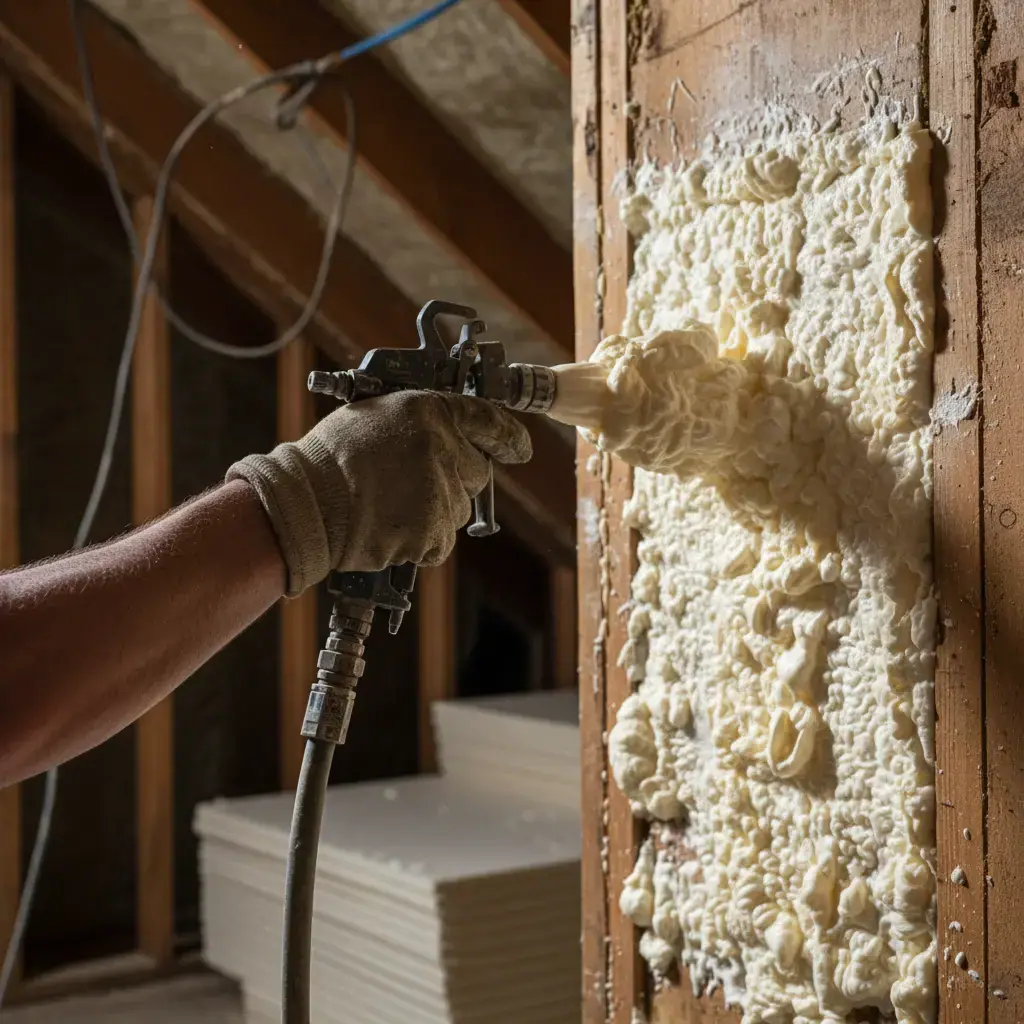
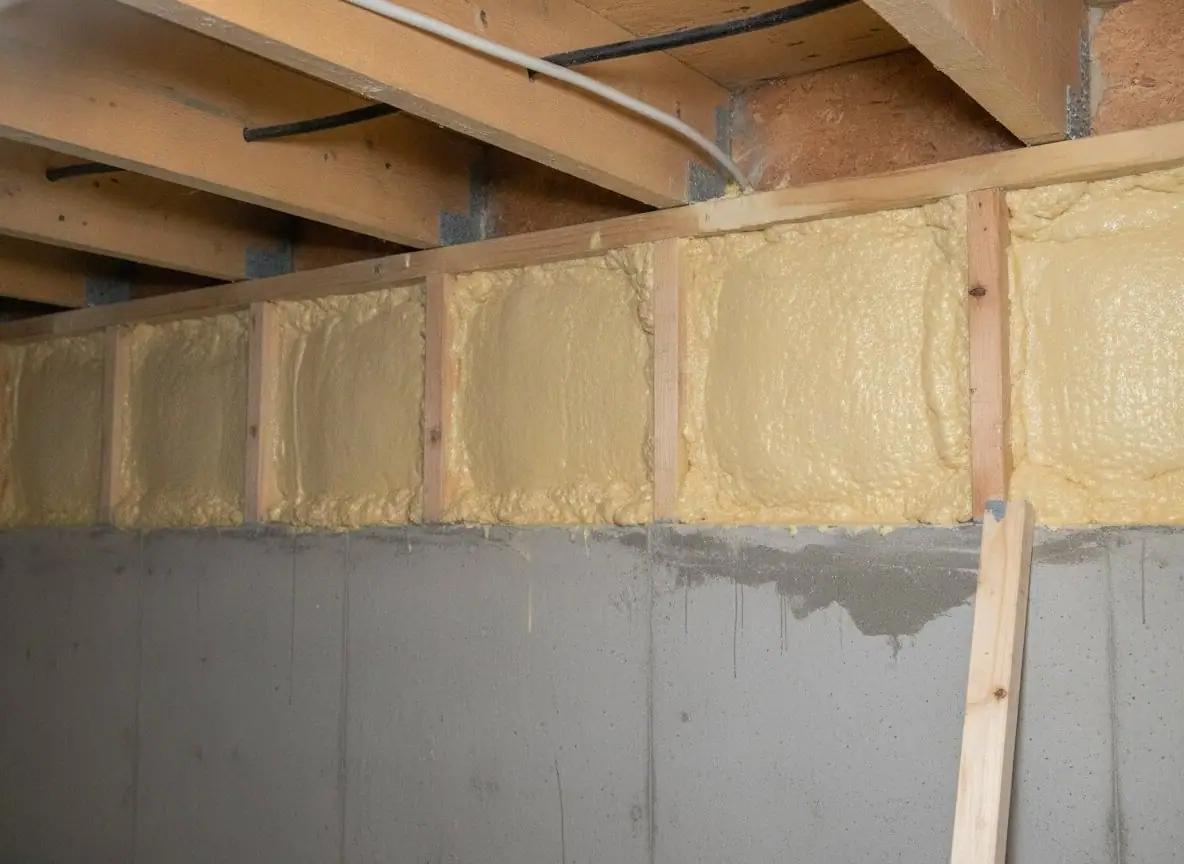
Spray polyurethane foam (SPF) is applied as a liquid that expands and hardens, sealing air gaps while providing insulation simultaneously. It comes in two forms: open-cell (R-3.5 to R-4 per inch) and closed-cell (R-6 to R-7 per inch). For Calabasas homes, closed-cell spray foam is particularly valuable because it also acts as a vapor barrier — useful during coastal humidity events — and adds structural rigidity to framing. It excels in attic roof decks, rim joists, and hard-to-reach cavities. Open-cell foam works well in interior walls where breathability is desired. The primary downside is cost: expect $1.50 to $3.50 per square foot for open-cell and $2.50 to $5.00 per square foot for closed-cell installed. Despite higher upfront costs, the air-sealing benefit alone often delivers measurable savings on Calabasas cooling bills.
Learn moreBlown-In (Loose-Fill) Insulation
Blown-in insulation uses a machine to distribute loose material — typically fiberglass or cellulose — into attic floors, wall cavities via drill-and-fill, and other enclosed spaces. Fiberglass loose-fill achieves R-2.2 to R-2.7 per inch, while cellulose reaches R-3.2 to R-3.8 per inch. This method is one of the most cost-effective upgrades for Calabasas attics, where inadequate coverage is extremely common. It conforms to irregular joist spacing and flows around obstructions, leaving fewer voids than batts. For Calabasas homeowners dealing with existing homes, blown-in insulation minimizes disruption — no drywall removal required for wall applications. Installation costs typically range from $1.00 to $2.00 per square foot. The main consideration is ensuring proper depth and density to maintain R-value over time, especially in drafty attic spaces exposed to Santa Ana wind pressure.
Fiberglass Batt Insulation
Fiberglass batts are pre-cut blankets of spun glass fibers designed to fit standard 16-inch or 24-inch stud and joist spacing. They offer R-values ranging from R-11 to R-38 depending on thickness. Batts are the most widely used insulation material in new construction across Calabasas due to their low cost and ease of installation. Pros include affordability ($0.50 to $1.50 per square foot installed), wide availability, and non-combustibility — an important consideration in Calabasas’s wildfire interface zones. Cons include susceptibility to performance loss if improperly installed, compressed, or exposed to moisture. Gaps and voids around electrical boxes or irregular framing can dramatically reduce effective R-value. Best applications include new-construction wall cavities, floor assemblies over unconditioned spaces, and attic floors where access is straightforward.
Mineral Wool / Rockwool Insulation
Mineral wool, sold under brands like Rockwool and Thermafiber, is manufactured from volcanic rock or industrial slag. It achieves R-3.0 to R-4.2 per inch and holds a distinct advantage in Calabasas: it is inherently fire-resistant, withstanding temperatures above 1,400°F before melting. In a community surrounded by fire-prone hillsides and classified within Very High Fire Hazard Severity Zones, this property is not trivial. Mineral wool also resists moisture absorption and provides excellent sound attenuation — beneficial in hillside homes subject to wind noise. It costs slightly more than fiberglass batts, typically $1.00 to $2.50 per square foot installed, but its dimensional stability and fire performance justify the premium for many Calabasas homeowners. Best applications include exterior walls, attic floors, garage ceilings, and any assembly where fire resistance is a code or insurance consideration.
Learn moreCellulose Insulation
Cellulose is made from recycled paper products treated with borate-based fire retardants, achieving R-3.2 to R-3.8 per inch. It is one of the most environmentally friendly insulation options and performs well in Calabasas attics when installed at the correct depth. Cellulose has excellent air-sealing characteristics when dense-packed into wall cavities, making it a strong retrofit option for older Calabasas homes lacking wall insulation. It also manages moisture through vapor diffusion more gracefully than some competing materials. Concerns include potential settling over time (reducing effective R-value by 15–20%) and sensitivity to prolonged moisture exposure. Installation costs run $0.75 to $1.75 per square foot. It qualifies for several California utility rebate programs, making the net cost very competitive. Best applications are attic floors, dense-pack wall retrofits, and enclosed cathedral ceiling assemblies.
Learn moreFoam Board (Rigid) Insulation
Rigid foam boards — including EPS (expanded polystyrene), XPS (extruded polystyrene), and polyisocyanurate — are manufactured panels offering R-3.8 to R-8 per inch depending on product type. Polyiso boards achieve the highest R-value per inch (R-5.5 to R-8) and are widely used in Calabasas re-roofing projects and exterior wall continuous insulation applications required under updated Title 24 codes. Foam board is also highly effective under concrete slabs and on foundation walls. It does not absorb moisture, making it suitable for Calabasas crawl spaces. A drawback is that most foam boards require a thermal barrier (typically drywall) when used in occupied spaces due to flammability. Installed costs range from $1.25 to $3.00 per square foot. Best applications include exterior continuous insulation layers, under-slab applications, garage doors, and basement or crawl space walls.
Why Calabasas Homeowners Trust Best Price Insulation for Insulation
Best Price Insulation brings deep material expertise and genuine local knowledge to every Calabasas project. Here is what sets our team apart:
Expertise Across All Insulation Types:
Expertise Across All Insulation Types:Our installers are trained and experienced with spray foam, blown-in, batt, mineral wool, cellulose, and rigid foam board — we recommend based on performance, not product markup.
Licensed and Insured:
Licensed and Insured:We carry full California contractor licensing and liability insurance, protecting your home and investment throughout every phase of the project.
Manufacturer-Certified Installation:
Manufacturer-Certified Installation:Certification by leading manufacturers ensures materials are installed to specification, preserving warranty coverage and maximizing R-value performance.
Free Insulation Assessment:
Free Insulation Assessment:We provide a no-cost, no-obligation evaluation of your current insulation, identifying gaps, moisture risks, and upgrade opportunities specific to your Calabasas home.
Warranty Coverage:
Warranty Coverage:We stand behind our work with both labor warranties and manufacturer product warranties so you have long-term assurance.
Local Energy Code and Rebate Knowledge:
Local Energy Code and Rebate Knowledge:Our team stays current on California Title 24 requirements and available utility rebates through SoCalGas and SCE, helping you capture every available incentive.
FAQ
Insulation Materials FAQ for Calabasas Homeowners
What is the best insulation type for Calabasas’s climate?
There is no single best material — it depends on location and application. For attics, blown-in fiberglass or cellulose with a radiant barrier is highly effective and cost-efficient. For complex framing, rim joists, or homes needing air sealing, closed-cell spray foam delivers the most comprehensive performance. Mineral wool is strongly recommended for any location where wildfire resistance is a priority. A combination approach typically yields the best results in Calabasas’s Climate Zone 9 conditions.
What R-value do I need for my Calabasas home?
California Title 24 for Climate Zone 9 requires a minimum of R-38 in attics for new construction, though R-49 to R-60 is recommended for maximum efficiency in Calabasas’s intense summers. Walls typically require R-13 to R-21 in cavities, with additional continuous insulation on exterior walls in newer code cycles. Floors over unconditioned spaces should reach at least R-19. An energy audit can determine the ideal R-value target based on your home’s specific framing depth, existing insulation, and duct configuration.
How do insulation material costs compare in Calabasas?
Fiberglass batts are the most affordable option at roughly $0.50–$1.50 per square foot installed, followed by blown-in cellulose at $0.75–$1.75 and blown-in fiberglass at $1.00–$2.00. Mineral wool batts run $1.00–$2.50. Rigid foam board falls in the $1.25–$3.00 range. Spray foam is the most expensive: $1.50–$3.50 for open-cell and $2.50–$5.00 for closed-cell. However, higher-cost materials like closed-cell spray foam often provide superior air sealing that can offset their cost through energy savings within a few years.
Is attic insulation or wall insulation more important for Calabasas homes?
Attic insulation almost always delivers a faster return on investment in Calabasas because the roof assembly receives direct solar radiation and generates the most significant heat gain. Most Calabasas homes lose more conditioned air through an under-insulated attic than through walls. That said, wall insulation significantly improves comfort in rooms facing south or west and reduces reliance on air conditioning. In older homes with no wall insulation, both upgrades are worthwhile — prioritize attic first, then walls.
How much energy can I save by upgrading insulation in Calabasas?
Properly upgrading attic insulation from minimal or degraded coverage to R-49 or higher can reduce cooling and heating energy use by 15–25% annually, according to the U.S. Department of Energy. In Calabasas, where summer cooling bills can be substantial, this translates to meaningful dollar savings year over year. Adding air sealing alongside insulation can push savings higher. Homes with older, inadequate insulation tend to see the most dramatic improvements after an upgrade.
Are there rebates or tax credits available for insulation in California?
Yes. Southern California Gas Company (SoCalGas) and Southern California Edison (SCE) both offer rebates for qualifying insulation upgrades, particularly attic insulation improvements that meet or exceed Title 24 minimums. The federal Inflation Reduction Act also provides a 30% tax credit (up to $1,200 per year) for qualifying home energy efficiency improvements including insulation. California’s Energy Upgrade California program may offer additional incentives. Eligibility and amounts change periodically, so we recommend verifying current offerings at the time of your project.
Can I add insulation on top of existing insulation in my Calabasas attic?
In most cases, yes — existing insulation in good condition can be supplemented with additional blown-in material to reach recommended R-value levels. However, if existing insulation is water-damaged, pest-contaminated, or contains old vermiculite (which may contain asbestos), full removal is necessary before new installation. A professional assessment will determine whether your current insulation can serve as a base layer or needs to be replaced entirely.
Does insulation help with wildfire risk in Calabasas?
Insulation itself is not a primary wildfire defense, but material choice matters at vulnerable points in your home’s envelope. Non-combustible materials like mineral wool batts and closed-cell spray foam do not contribute fuel in the event of ember intrusion into attic or wall spaces. Fiberglass is also non-combustible. Paper-faced batts and cellulose, while treated with fire retardants, offer less resistance. For homes in Very High Fire Hazard Severity Zones, combining non-combustible insulation with ember-resistant venting and sealed attic penetrations provides a more complete approach.
Get a Free Insulation Assessment in Calabasas
Not sure which insulation material is right for your Calabasas home? Best Price Insulation offers a free, no-obligation assessment that takes the guesswork out of the decision. Our trained technicians will evaluate your attic, walls, and crawl space, measure existing R-values, identify air leakage points, and recommend the most effective materials for your budget and your home’s specific climate exposures.
We serve Calabasas and the surrounding communities with licensed, insured installation across all major insulation types. Our team understands local Title 24 requirements and can help you identify available California utility rebates and federal tax credits to reduce your net cost.
Call us today at (818) 696-4154 to schedule your free assessment and take the first step toward a more comfortable, energy-efficient Calabasas home.
Why choose us
Why choose Best Price Insulation?
Free estimates
Get a clear, no-obligation estimate before any work begins.
Licensed & insured
Your property and our crew are protected on every project.
Residential & commercial
One team for homes, multi-family and commercial properties.
Locally owned & operated
A local team serving your community and the surrounding area.
Get in touch
Find insulation help near you
Request a free estimate online or give us a call — our team will follow up quickly.
- Call us(818) 696-4154
- Visit26635 W Agoura Rd, Calabasas, CA 91302
- HoursMon-Sun 07:00-19:00